Retired Nurse-Midwife Reveals a Forgotten 28-Day African Herbal System That Helps Nigerian Women With Severe Period Pain Finally Stop Buying Painkillers That No Longer Work
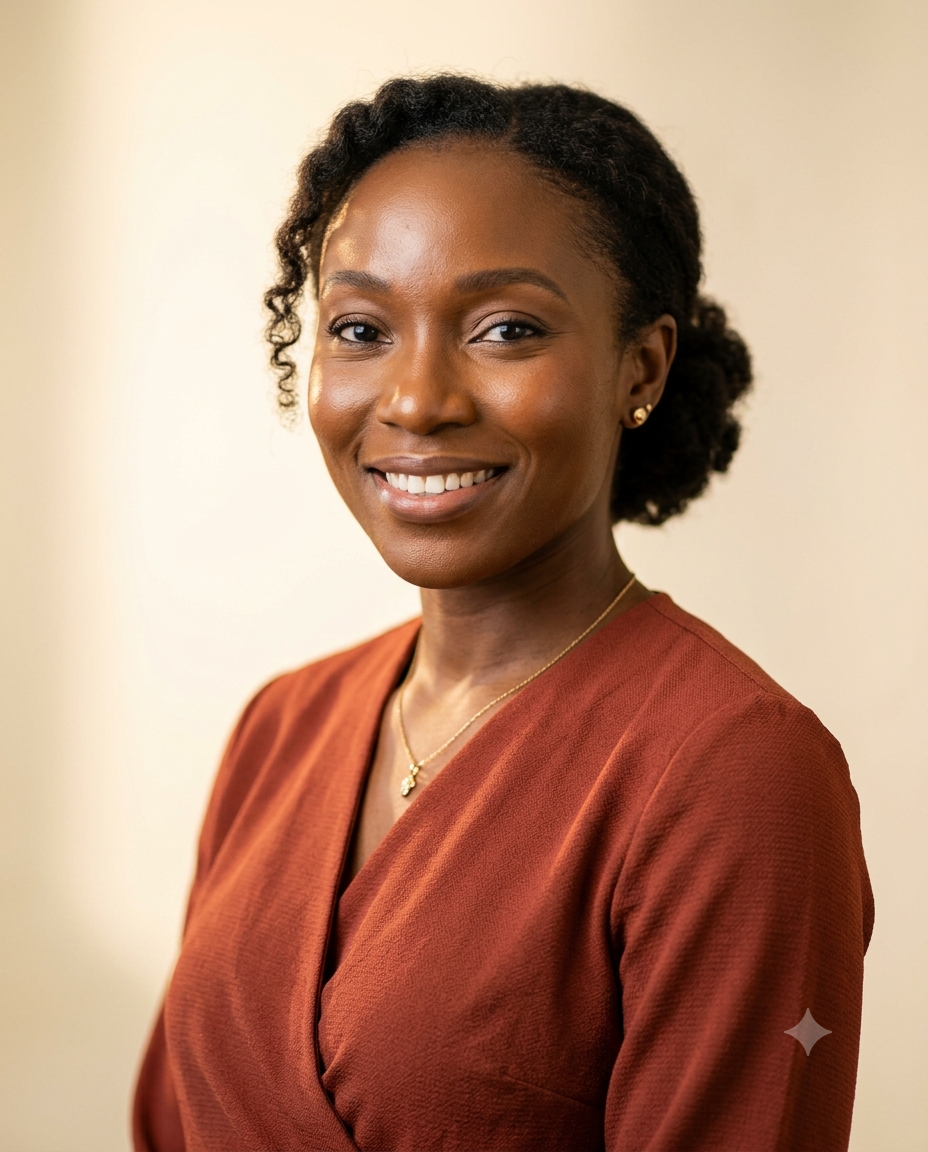
You know exactly how this story goes.
It starts about four or five days before your period actually arrives — that low, quiet heaviness in your lower back. Your body already knows what is coming. And somewhere in the back of your mind, so do you.
You start mentally rearranging your calendar. You send a message to cancel the Friday plans. You make sure there are Felvin and ibuprofen in your bag, in your desk drawer, in the bathroom cabinet — just in case. You have learned to over-prepare, because nothing is worse than being caught without them.
This month will be different. I'll catch it early. I'll take the painkiller before it gets bad this time.
Then Day 1 arrives.
And it does not care that you were prepared.
Within two hours you are bent forward in your chair, pretending to read something on your screen while actually just trying not to make any sudden movements. The cramping is coming in waves now — that deep, grinding, twisting pain that lives somewhere between your lower stomach and the top of your thighs, radiating down your back like a slow fire. Your colleagues cannot see it. You have gotten very good at looking fine when you are absolutely not fine.
I cannot leave my desk again. They are going to start thinking something is wrong with me.
You take the first painkiller. You wait. You take a second one ninety minutes later because the first one barely touched it. At some point the pain quiets to a 6 or 7 out of 10 — which, compared to what it was at 8am, feels almost like relief. This is what your life has become. A 6 out of 10 pain is a good day.
You have tried other things. Of course you have. Ginger and lemon tea — every morning for three months, religiously, before you gave up. Magnesium capsules you bought after a viral Facebook post. Hot water bottles pressed hard against your stomach at midnight, the rubber leaving a red oval mark on your skin. You have tried the agbo from that woman in Oshodi market — the one who swore it worked for her sister. It helped for exactly one cycle and then stopped working entirely.
Your doctor — the one time you finally went — told you it was "normal." That dysmenorrhea was common and that ibuprofen was the appropriate management. He printed a leaflet. You took it home and put it on your bedside table. It is still there.
Normal. As if lying on the bathroom floor at 3am gripping the toilet bowl is normal. As if missing three to four days of work every single month is normal. As if this is just what women are supposed to do.
And there is the other thing. The thing you have not told anyone except maybe one close friend — the quiet fear that lives in the back of every conversation you have with yourself about your body. Because you have read things. You have been in the Facebook groups. You know that severe, recurring menstrual pain can sometimes mean something more serious is happening — fibroids, endometriosis, things that affect whether you will one day be able to carry a pregnancy. You have not gone to get checked because you are terrified of what they might find. And you have not not gone because you are fine — you have not gone because ignorance feels safer right now than confirmation.
You are 26 or 32 or 38 years old and you have been living this way for years. Quietly. Efficiently. Pretending.
You are exhausted.
Drop everything you are doing right now and read every single word on this page. Because I am about to share something that changed my life completely — and I believe with everything in me that it can change yours too.
Because I'm about to share with you a simple 28-day herbal preparation system that changed everything for me — and helped me go from bedridden and medicated every month to sitting through a full working day without a single painkiller.
Our grandmothers knew something we have forgotten.
Before there were Felvin and Buscopan and ibuprofen blister packs in every pharmacy — before painkillers became the default answer — women in this part of the world managed their cycles using systems that had been passed down quietly for generations. Not because they were poor and had no choice. Because these systems actually worked.
This method is not new. It is not trending. It will not appear on WebMD or in a pharmaceutical brochure. But it has been quietly working in households across Eastern Nigeria for longer than any of us have been alive. And the reason most of us never learned it is simple: the women who held this knowledge were never asked to share it. They assumed we knew. And then the painkillers arrived and we all stopped asking.
Until I asked.
Hi. My name is Adaeze Okonkwo. I am a marketing executive. I am based in Lagos. And the first thing you should know about me — the most important thing — is that I am not a doctor. I am not an herbalist, not a nutritionist, not a medical professional of any kind. I am just a regular woman from Enugu State who suffered debilitating menstrual cramps for twelve years and finally, accidentally, stumbled onto the thing that actually stopped them. And I am telling you this story because I cannot keep it to myself anymore.
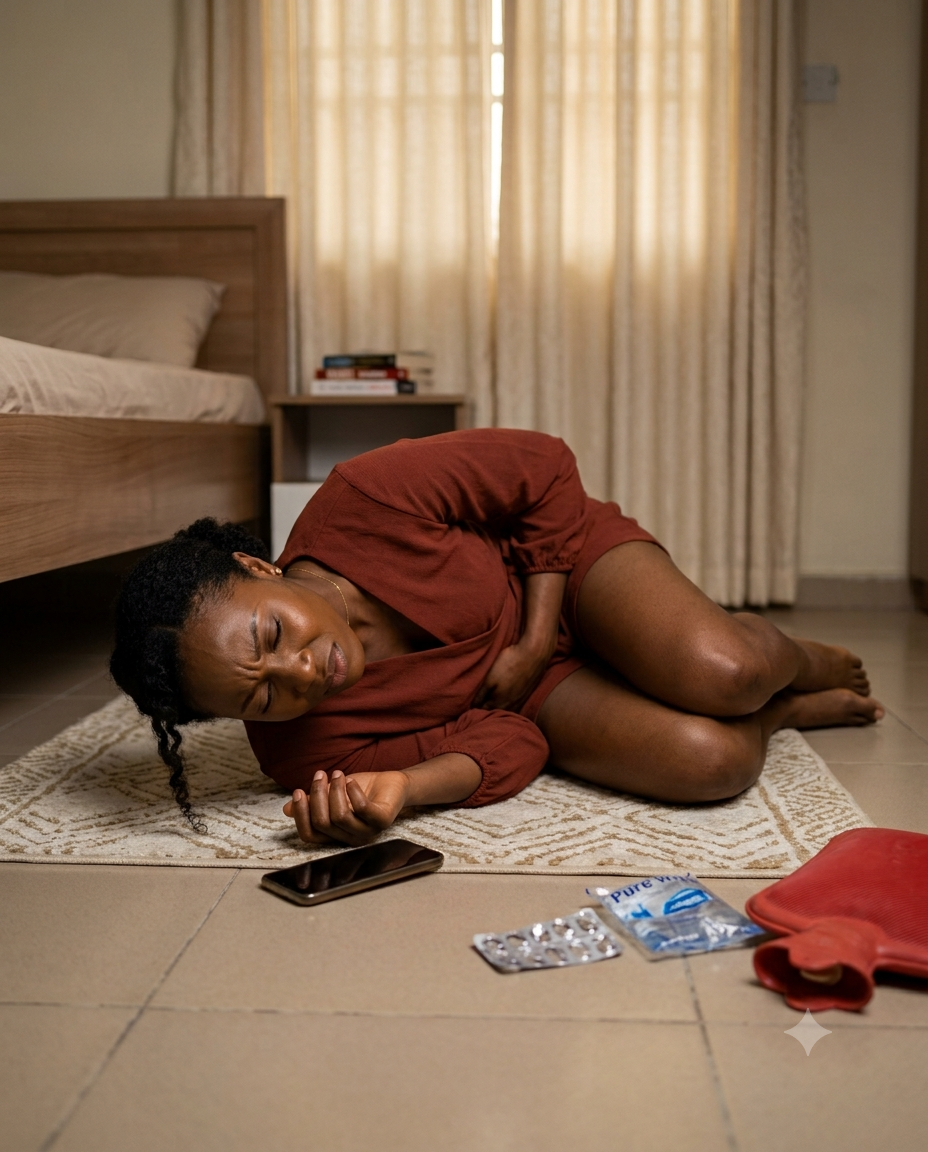
My Story — From Sixteen Years Old to the Floor of Mama Ngozi's Parlour
The cramps started when I was sixteen.
I remember the first truly bad one. I was in JSS3, sitting for a mid-term exam at school, and the pain came on so suddenly and so violently that I had to excuse myself from the examination hall. I sat outside on the veranda with my knees pressed to my chest, rocking slightly, telling myself it would pass. It passed after about four hours. I went home and my mother gave me two Buscopan and said: "That is how it is. Your own is just a little strong. You will get used to it."
I never got used to it.
From sixteen to twenty-eight, my life was structured around my menstrual cycle. Not in the empowering, cycle-syncing way the wellness bloggers talk about. In the survival way. I would feel the pre-period signs coming — the bloating, the irritability, the specific heaviness in my lower back — and I would mentally prepare for what was coming like someone preparing for a small disaster.
I took Felvin. Then Felvin and ibuprofen together because one alone stopped being enough. Then Buscopan added in for the cramping. By the time I was in my mid-twenties I was taking combinations that I should have been questioning, and I was not questioning them because the alternative — going back to that level of pain without medication — was not something I was willing to do.
My career was the first casualty. I worked hard to get to the executive level. I work at a marketing firm in Lagos — we handle brand campaigns for consumer companies, and my role requires me to be visible, present, switched-on. There is no version of my job that accommodates a woman who disappears for two to three days every month and returns looking like she has not slept.
I developed a story. Low blood pressure. I am one of those people who gets occasional episodes of low blood pressure and needs to rest. I told it so many times it stopped feeling like a lie and started feeling like a second identity.
The day I almost passed out in a client presentation — I was presenting quarterly brand performance metrics for a major client, standing at the front of a boardroom in Victoria Island, and the cramp hit about forty minutes in. Not a warning cramp. A full, blinding wave. I gripped the edge of the table, kept talking, and then my vision started to go grey at the edges. I asked one of the junior account managers to take over for a moment, excused myself, and sat in the bathroom stall for twenty minutes until the worst of it passed. I went back into the boardroom and finished the presentation. Afterwards, my manager pulled me aside and asked if I had low blood sugar. I said yes.
That was the most dishonest I have ever been in my professional life. And I had to be, because the truth — sorry, I have severe menstrual cramping that periodically incapacitates me for days at a time — is not something a woman says in a Lagos boardroom if she wants to be taken seriously.
Then came the blood test.
I did a routine health check in September 2023. Comprehensive bloodwork. Three days later my pharmacist — a kind older man near my flat in Lekki who has been dispensing my ibuprofen and Felvin for two years — called me to come in. He sat me down. He showed me my liver function results. He pointed to two specific numbers. He said: "These are not alarming yet. But they are showing early stress signals, and I have been filling your prescriptions long enough to know why."
He said it gently. He was not trying to scare me. But I sat in his pharmacy chair and felt something shift underneath me, because I was looking at proof — actual numbers on a page — that the thing I had been doing to survive was quietly damaging something else. I was trading my womb's suffering for my liver's suffering. And I did not know how to stop.
I tried everything I could find. And I tried all of it seriously — not halfway. I kept a notes app log.
Ginger and lemon tea — I drank this every morning for three months straight. It was soothing and it helped with the pre-menstrual bloating slightly. But on Day 1, when the serious cramping arrived, the ginger tea was useless. It was like trying to stop a flood with a teacup.
Agbo from the market in Oshodi — A woman in my building swore by a particular vendor there. I bought it, prepared it exactly as instructed, took it for the full five days before my cycle. First month: noticeable reduction. I was excited. Second month: same vendor, same instructions, the exact same preparation — absolutely zero effect. I suspect the ratios of the herbs were different. There was no consistency, no documentation, no way to replicate what had worked.
Vitamin D3 and magnesium — This went viral in one of the women's health Facebook groups I am in. Fourteen hundred comments. Women swearing by it. I bought the capsules, took them faithfully for six weeks at the recommended dosage. My next period was as bad as it had ever been. I posted in the group asking if anyone else had experienced this and was told I needed to wait three to four months for the build-up effect. I waited four months. Nothing changed.
The hot water bottle — This is not a remedy. This is pain management. There is a difference. The heat helped with the surface discomfort and sometimes let me drift off to sleep during the worst hours. But the deep, internal cramping — the kind that makes standing up feel impossible — the hot water bottle does not reach that. It never reached it.
Vitamin B1 (Thiamine) — From a journal article someone shared in a group. I sourced it, took it. Mild and inconsistent improvement, nothing significant enough to reduce my painkiller dependence.
I was beginning to accept that this was simply my life. That I was one of those women for whom no natural solution worked, and that my only options were to continue damaging my liver or to live in disabling pain every month until menopause saved me somewhere in my late forties.
Then I went home to Udi for Christmas.
I had not been home in three years. Life in Lagos does not leave much room for going back — the travel, the cost, the time. But my mother had started calling more frequently, with a tone in her voice that communicated more than her words did, and I decided it was time.
My grandmother — Mama Ngozi, my father's mother — is 81 years old and lives in the same compound in Udi Local Government Area where she has lived for fifty years. She is small and sharp-eyed and her hands always smell of dried uziza leaves and camphor. She spent almost thirty years as a traditional birth attendant in that community — she told me once that she assisted over four hundred births between 1968 and 1997. She raised seven daughters. She has forgotten more about women's health than most people alive will ever know.
I arrived on the 24th of December 2023. Travel stress, I suspect, triggered my period two days early. By the morning of the 26th I was on the parlour floor — I had come down from my room in the early hours when the pain woke me, and I had not made it back up. I was lying on my side on the parlour rug with my knees to my chest, waiting for the ibuprofen I had taken at 3am to do something useful.
Mama Ngozi found me at about 6am when she came downstairs to start the morning.
She stood in the doorway and looked at me for a long moment. I expected the usual — "Get up, what is this, endure it, that is womanhood." Every older woman I had ever encountered in these moments delivered some version of that speech.
Instead she was quiet. Then she said, in Igbo: "This one has been going on too long. Nobody showed you what to do."
She took my hand. She helped me up. She walked me out to the backyard — her herb garden, which I had played in as a child without ever understanding what any of it was — and she began to talk.
She talked for four hours. Between cooking, between receiving Christmas visitors, between scolding a grandchild who had gotten into the palm wine — she talked. And I wrote everything down in my phone's notes app, asking her to repeat things, asking her to spell Igbo herb names, asking her the same questions three different ways to make sure I understood.
What she told me rearranged everything I thought I understood about my own body.
"The women who suffer like you," she said, "they are not suffering because they are weak. They suffer because the womb is being told to do too much, too hard, all at once. And the reason it does too much is because the body has been inflamed for weeks before the period even arrives. You take the painkiller on Day 1 but the problem started on Day 22 of your last cycle. By the time you feel the pain, you are already fighting a losing battle. You have to start five days before."
She explained that severe cramping is not simply pain — it is the body producing prostaglandins, substances that cause the womb to contract, but in much higher quantities than necessary. And that inflammation in the body — the kind that builds silently from certain foods, from stress, from specific nutritional deficiencies — dramatically amplifies how much of this substance the body produces. The cramping is the end of a chain. She was going to teach me how to interrupt the chain much earlier.
She showed me her herb garden. She named five specific herbs and explained each one — what it did, why it was part of the system, how to source it in any market, how to prepare it correctly, and critically, when in the cycle to take each one and in what sequence. Because, she said, the sequence matters. Taking the right thing at the wrong time is the same as taking nothing.
She also taught me the emergency preparation. The one blend — three specific ingredients combined in precise proportions, prepared in under twenty minutes — that she had given to women throughout her decades as a birth attendant whenever they arrived at her door in active menstrual crisis. "This one," she said, holding up the dried leaves, "I have never seen it fail to bring some peace within the hour." Not by numbing the pain the way a painkiller does. By addressing what is actually causing the womb to contract so violently in the first place.
She also told me which foods I was eating every day that were quietly making everything worse. Some of them shocked me. Some of them made complete sense the moment she said it.
I was skeptical. I will not lie to you.
I had been through too many things that had promised and disappointed. The ginger tea. The magnesium. The agbo. I sat across from my 81-year-old grandmother in her Udi backyard and thought: This is going to be another thing that works for three women and does nothing for me. I loved her. I trusted her. I still thought it probably would not work.
I returned to Lagos in early January 2024 and I started the preparation system the following week, for the period I was expecting around January 15th.
The first three days of the preparation window — nothing. I was taking the first herbs in the sequence and feeling no different. My internal monologue was not optimistic.
This is not going to work either. I should at least make sure I have Felvin in the house.
Day 4 — I noticed I was sleeping better. More deeply. The pre-menstrual irritability that I had accepted as an immovable part of my personality for two weeks every month was… quieter. Not gone. But noticeably quieter.
Day 5 — the bloating I normally lived with for the five days before my period was significantly reduced. I was not distended by 7pm the way I normally was. I put on jeans that normally I cannot comfortably wear in the pre-period week. They fit normally.
When my period arrived, I was in the office.
The cramping came. I want to be clear about this — it came. This is not a story about no pain. The cramping arrived at around 10am on Day 1, and I felt it.
But it was a 3 out of 10.
Not my usual 8 or 9. Not the kind that requires lying down. Not the kind that makes standing at the coffee machine impossible. A 3 out of 10. Uncomfortable. Unmistakeable. But manageable.
I sat through a full day of meetings. I presented a campaign concept to a client at 2pm. I walked to a restaurant for lunch. I took no painkillers. I went home on the bus.
I cried in the office bathroom at lunchtime. Not from pain. From the shock of a completely normal day.
By the second month, the cramping had reduced further. By month three, it was what I can only describe as a background sensation — present and recognisable as period pain, but something I could work through, sit through, live around. Not something that required medication. Not something that required lies.
On the evening of my third completely unmedicated period, my boyfriend Emeka looked up from his phone and said: "Adaeze — are you okay? You seem… normal. Like actually normal."
I told him what I had been doing. I showed him the notes I had taken at Mama Ngozi's. He was quiet for a moment, and then he said: "So your grandmother just had this the whole time and nobody told you? That is actually a criminal offense."
He is not wrong.
I should say — I was not the only one at that Christmas gathering who was suffering. Three of my cousins are in their twenties and thirties. Two of them had been dealing with the same thing for years. By the time I left Udi on the 28th of December I had shared everything I had written down with both of them.
Chioma, 29, from Owerri — she messaged me in February 2024 to say: "Adaeze I swear to God. First month I thought it was a fluke. Now it is March and I have not touched a single Felvin. I don't know whether to thank you or be angry that nobody told us this before."
Ifeoma, 34, from Abuja — she was more cautious with her words. She sent me a voice note in March. She said: "I am not going to say anything dramatic. I will just tell you that I went back to work on Day 1 for the first time in four years. You know what that means."
Ngozi Eze, a close friend who had watched me cancel plans for years — she asked me to share the preparation with her after I told her about my results. She reported back after two months that her cramps, while not eliminated, had dropped from unbearable to manageable, and that she had been able to reduce her Felvin intake by about 70%.
Three women. Different bodies. Different cities. Consistent results.
I knew then that this was not just for me. I had to do something with it.
The messages started coming about four months later.
I had mentioned my experience briefly in a women's wellness Facebook group — nothing detailed, just that I had found something that was working for me and that it came from my grandmother. The DMs were immediate. Then persistent. Then overwhelming. I had women messaging me at midnight asking if I could share what I had found. Women from Lagos and Abuja and Port Harcourt, and women in London and Houston and Toronto who had carried this problem across borders with them and still could not solve it.
I cannot personally walk every woman through this by DM. I tried for a while. It is not sustainable. And the instructions matter — the sequence matters, the sourcing matters, the preparation method matters. Sending a four-line summary is not enough.
So I did it properly. I went back to Mama Ngozi in June 2024. I spent three days going through every detail with her again, this time recording everything. I hired a certified women wellness coach in Abuja to review and document each formulation. I worked with a nutritionist to develop the Nigerian food compatibility section — the specific guide to which everyday Nigerian foods help or worsen the condition. And I had the symptom decoder section reviewed by a medical professional before I published anything. I wanted to do this right.
I put everything — the full system, the five herbs, the exact sequence, the timing, the sourcing guide for every Nigerian market and for diaspora buyers abroad, the emergency same-day preparation, the food guide, and the guide to understanding your own symptoms — inside one single, easy-to-read PDF guide that you can access within minutes of ordering.

"The Last Painkiller: What Our Grandmothers Did Before the Painkillers Came"
A Complete 28-Day African Herbal System for Severe Menstrual Cramping
Inside This E-Guide, You'll Discover:
- Why your painkillers stopped working — and why that is not your fault. The biology of painkiller tolerance explained in plain, honest English — no jargon, no judgment, just the truth about what has been happening in your body. — Pg. 3
- The three root causes of severe menstrual cramping in African women that almost no Nigerian doctor discusses in a standard consultation — including the one that is driven almost entirely by what you are eating in the two weeks before your period arrives. — Pg. 7
- The complete 5-Day Pre-Period Preparation Ritual — exactly what to take, when to take it, in what sequence, beginning five days before your cycle. This is the core of the whole system. The preparation window is where everything changes. — Pg. 14
- The Nigerian Anti-Cramp Herbal Stack — the five specific herbs used in Mama Ngozi's system, where to source each one in Nigerian markets, and the diaspora sourcing guide for women in the UK, USA, and Canada. Includes exact preparation methods — not general instructions, precise ones. — Pg. 19
- The Emergency Same-Day Relief Preparation — the single herbal blend you can prepare in under 20 minutes that provides noticeable relief within 45 to 90 minutes of your first dose. Not numbing. Not suppressing. Addressing the physical cause of the contraction itself. — Pg. 28
- The Nigerian Food Compatibility Guide — which everyday Nigerian foods reduce inflammation and which dramatically worsen cramping, with simple adjustments that do not require you to abandon your cuisine. You will be shocked by some of what is on this list. — Pg. 33
- The "Is This More Than Cramps?" Symptom Decoder — a plain-language guide to understanding whether your symptoms warrant investigation for fibroids or endometriosis, and exactly how to walk into that medical appointment as an informed, prepared advocate for yourself. — Pg. 39
💬 Real Women. Real Testimonials.
Adaeze I no fit lie to you. The first month I thought na coincidence. Second month I started believing. Third month — I went clubbing on Day 1 of my period. ME! A person wey don dey cancel plans every month since 2018. The herbs are easy to find and the instructions are so clear even my cousin who no dey read too well understood am. This thing is real.
I have been in the diaspora for six years and I have been dragging my period pain with me across the Atlantic the whole time. Tried everything from UK Holland & Barrett, tried everything my mum sent from Nigeria, nothing was consistent. I found all five herbs on the sourcing list within three days — two from an African shop in Peckham and the rest online. By my second cycle on this system I went to work on Day 1 for the first time since I moved here. I actually cried on the Tube. I don't even care.
What convinced me to try this was the food guide. I didn't even get to the herbs first — I just changed the three things the guide said were making inflammation worse, and even THAT alone reduced my pre-period bloating within two weeks. When I added the herbal prep on top of that, ehn. My husband said I looked different. Like less… braced. Like I wasn't constantly anticipating pain. That is exactly how I felt. Less braced. I didn't know that was even possible.
I'm a nurse here in Houston so I was skeptical. Very skeptical. But I was also desperate because nothing in the medical system here had helped me beyond "take ibuprofen." The symptom decoder section alone was worth the price — it helped me understand something about my own symptoms that I then took to my OB and she actually agreed with my assessment and ordered the right tests. The system itself has been reducing my cramping consistently over three months. I'm not 100% pain-free but I am probably 70% better and that 70% has given me my life back.
Abeg the emergency preparation alone worth every kobo. I made it the first time when my period came before I had finished the prep window — I thought it wasn't going to work because I hadn't done the full five days. Within one hour my cramping went from a 9 to a 3. I was lying down ready to miss another day of work and I stood up, ate something, and went back to the office. My colleague asked why I was there — she knows my monthly disappearing act. I told her I found something. She wants the guide now too.
Just So You Know… Putting This Guide Together Cost Me Over ₦137,500
I did not just write this from memory and call it a day. I wanted this to be accurate, safe, and actually reproducible by any woman — whether she is in Oshodi or London. So I invested in doing it properly.
- Certified women wellness coach (Abuja) — formulation verification and documentation ₦45,000
- Nutritionist — Nigerian food compatibility mapping and inflammation research ₦32,000
- Medical Reviewer — symptom decoder accuracy and safety check ₦28,000
- Diaspora herb sourcing research (UK, USA, Canada) ₦18,500
- Design, layout, and PDF formatting ₦14,000
I am not going to charge you ₦137,500. I would not do that to you.
Not even
Not even
Not even the original fair price of
Today, Your Investment is Just:
One-time payment. Instant digital access. No monthly fees. No subscriptions.
No timer. No trick. I simply committed to making this accessible to the first fifty women who found it — because I remember exactly what it felt like to be in pain every month.
🔒 Secure payment via nestuge · Bank Transfer · USSD · Card · Instant Access After Payment
🎁 WAIT! I Have FREE Gifts For You…
If you are among the first 50 women to order today, you will receive these two bonuses alongside the guide. (TODAY ONLY)
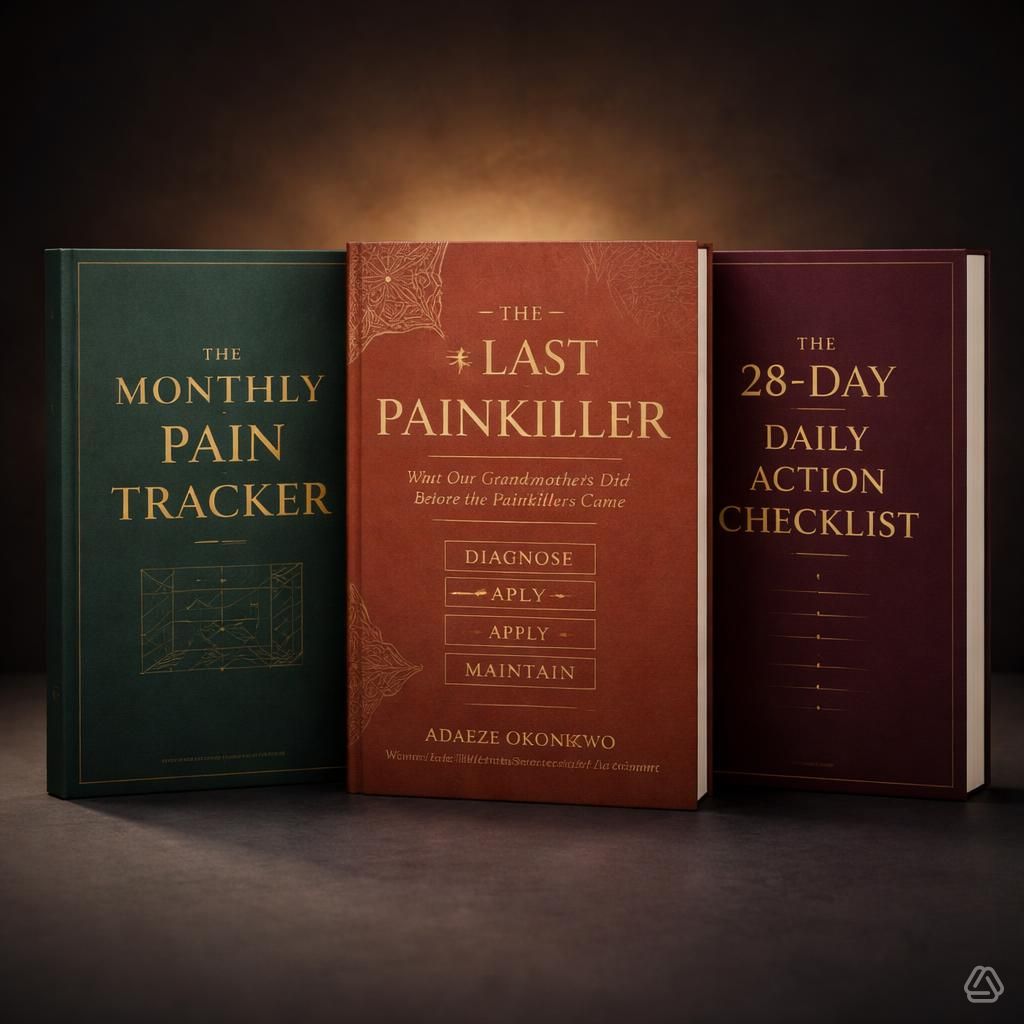
🎁 BONUS #1: The Monthly Pain Tracker
A printable 3-month tracking sheet that helps you measure your own progress cycle by cycle, identify your personal triggers, and build the evidence you need if you ever decide to take your case to a doctor.
Because data is power — and you deserve to walk into that consultation armed and informed.
Value: ₦3,500 — Yours FREE
🎁 BONUS #2: The 28-Day Daily Action Checklist
A simple day-by-day checklist that removes every drop of guesswork from the protocol. Each morning you open it, follow the 3–5 actions listed for that day, and close it. No re-reading the guide. No wondering what comes next.
Just follow the list and let the system work.
Value: ₦2,500 — Yours FREE
Total Value: ₦20,800
Yours Today: ₦9,800 (or ₦4,800 for first 50)
⚡ First 50 orders at ₦4,800 · Instant Digital Access After Payment
👀 See What Is Happening Right Now…
37 women have already claimed their copy at the discounted price.
Only 13 copies remaining at ₦4,800.
Bear in mind — you are not the only one viewing this page right now.
Only 13 spots left at ₦4,800 · After that it returns to ₦9,800
My 30-Day "It Works or You Pay Nothing" Guarantee
Still feeling unsure? I completely understand. You have tried things before that did not work. You have spent money on promises that disappointed you. I know exactly how that feels, because I lived it for twelve years.
Which is why I am making you this bold, risk-free promise:
Follow the system exactly as described in the guide for 30 days. If you do not notice any meaningful improvement in your cramping — if you genuinely follow the protocol and feel it made no difference whatsoever — send me a message and I will refund every kobo. No questions. No forms. No arguments.
I can offer this guarantee because I have seen this system work consistently. I am not worried about refund requests. But I want you to know that the risk is entirely on my side — not yours.
To request a refund within 30 days, simply email the address provided in your order confirmation.
✅ Yes! I'm Ready — Get Me The Guide Risk-Free💬 More Real Women. More Real Results.
I have been in Canada for eight years. Period pain came with me when I moved and never left. I have seen three different doctors here and been told every single time to take over-the-counter ibuprofen. The sourcing guide in this book helped me find everything I needed within a week — one African grocery in Mississauga had three of the five herbs. The rest I ordered online from a UK supplier listed in the guide. After two months: I am sitting here writing this testimony on what would have been my worst day. Drinking tea. Laptop on my lap. Not doubled over. I cannot explain how surreal this feels.
I am from Enugu so when I saw this was based on Igbo herbal tradition I knew it was real. We have always had these herbs here — I pass them in the market every week without knowing what they do. The guide taught me the names, the uses, and exactly how to prepare them. My first cycle after starting: I spent Day 1 cooking pepper soup and watching TV. My mother walked into the kitchen and said "are you not sick?" Because she knows. Because she has been watching me suffer every month since I was 17. She cried. I cried. Thank you Adaeze. From the bottom of my womb, thank you.
I was genuinely thinking about surgery before I found this. My cramps had gotten bad enough that my doctor was starting to talk about investigating further. I bought the guide while waiting for my appointment, honestly just to feel like I was doing something. The symptom decoder section gave me language to use in that appointment — actual clinical language that made my doctor sit up differently. She ran the proper tests (nothing serious found, thankfully). And meanwhile the herbal system has been reducing my cramping so consistently that I have cut my painkiller use to almost zero over three months. Do not wait. Just get it.
My husband bought this for me after I spent the whole of last November in bed. He found the page, read the whole thing, and just paid and sent me the link. He didn't even tell me what it was — he just said "try this, please." I was skeptical but I tried it because he asked. Ehn, what can I say. Month two: I woke up on Day 1, made breakfast, went for a walk. My husband looked at me like I had been replaced by someone else. He said "is this the same woman I married?" 😂 I am so grateful. Both of us are grateful. This guide has genuinely changed things in our home.
I work in healthcare here in London so I approached this with my clinical hat on. I researched the five herbs independently before starting. Everything Adaeze describes is supported by existing ethnobotanical and pharmacological literature — the mechanisms are real, the anti-inflammatory and antispasmodic properties are documented. What the guide adds that no academic paper gives you is the practical system: the sequence, the timing, the preparation, and critically the Nigerian food context which is completely absent from Western literature. It works. It is well-documented. And at ₦9,800 it is the most cost-effective intervention I have found after years of searching.
You Are At a Decision Point Right Now.
There are only two directions from here:
✅ Option A — Take Action Today
Get "The Last Painkiller." Follow the 28-day system exactly as Mama Ngozi taught it. Go into your next period prepared. Sit through your next working day without painkillers, without lying to your boss, without apologising for your body. Regain two to three days every single month that currently belong to pain. That is 24 to 36 days per year. Every year. For the rest of your reproductive life.
❌ Option B — Close This Page and Keep Going Alone
Continue the Felvin. Continue the Buscopan. Continue rearranging your calendar, lying about low blood pressure, cancelling plans, lying on the floor. Continue ignoring the quiet fear about what the pain might mean. Continue watching the numbers on your blood tests that your pharmacist is already watching. Maybe you'll find something better elsewhere. Maybe you won't. You know your track record with that search better than I do.
⏰ The clock is ticking. The first 50 spots at ₦4,800 will not stay open forever.
Maybe God wanted you to see this page today. Who knows. But you are here. And now you have a choice.
🔒 100% Secure · Instant Access · 30-Day Money-Back Guarantee · ₦9,800 (₦4,800 for first 50)
Questions? Contact us via the nestuge platform after purchase.
© 2025 Good Health Hub · All Rights Reserved
💬 Share Your Experience